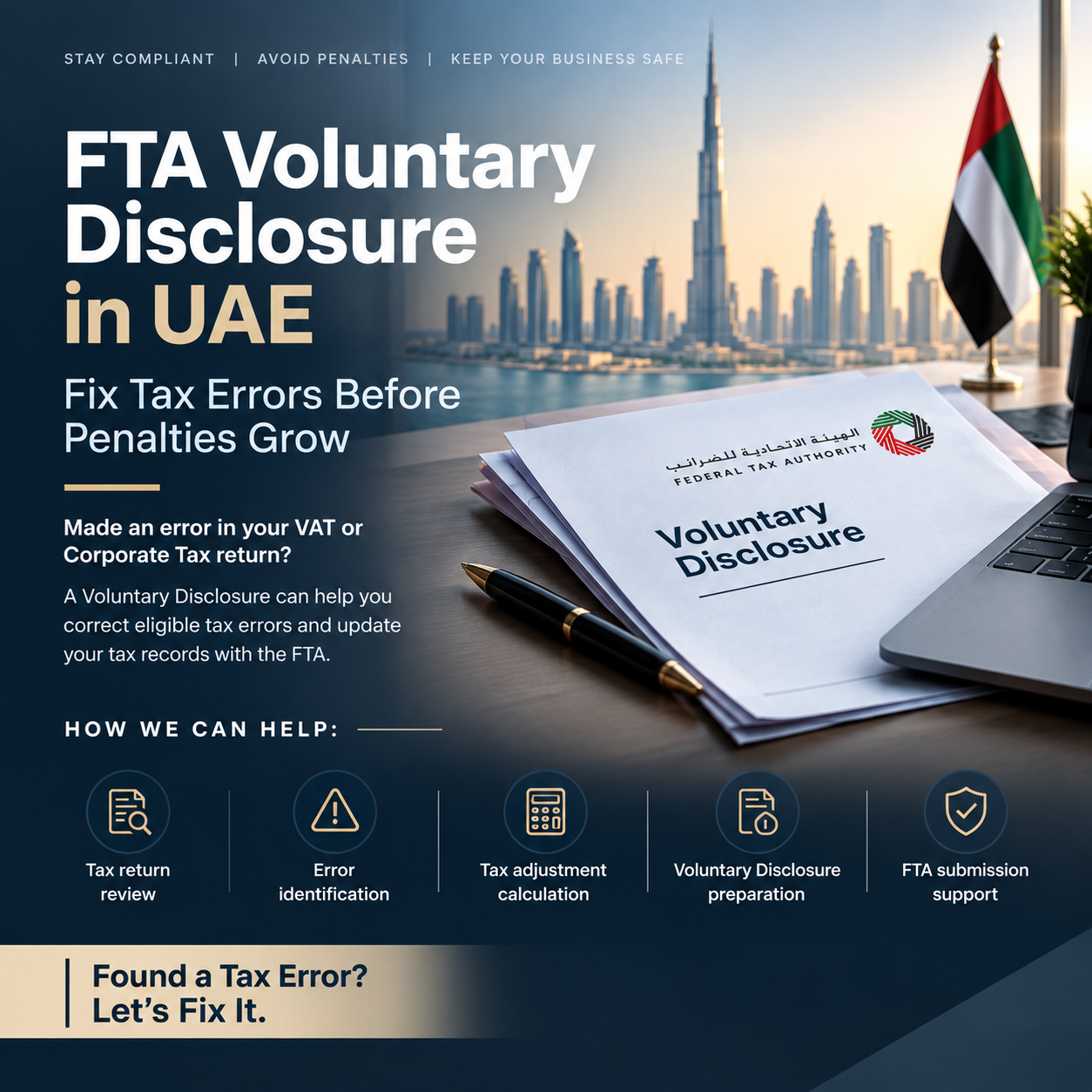
Every business makes mistakes. An invoice posted to the wrong period, an input tax claim that shouldn’t have been taken, a transaction classified under the wrong VAT category — these errors happen. What separates a manageable correction from a devastating penalty is whether you find it first, or the FTA does.
The UAE’s Voluntary Disclosure mechanism exists precisely for this situation. It lets you approach the Federal Tax Authority on your own terms, correct the error, and pay what is owed — at a significantly lower penalty rate than if the FTA discovers the mistake during an audit. Used correctly, it is one of the most powerful compliance tools available to businesses in the UAE.
This guide explains exactly what voluntary disclosure is, when you must file one, how the penalty calculation works, and what the process looks like step by step on EmaraTax.
What Is a Voluntary Disclosure?
A Voluntary Disclosure is a formal notification submitted through the FTA’s EmaraTax portal in which a Taxable Person informs the authority that a previously filed tax return — or a tax assessment issued to them — contains an error or omission.
The legal basis is Article 10 of the Tax Procedures Law (Federal Decree-Law No. 28 of 2022, as updated by Federal Decree-Law No. 17 of 2025), which obliges a Taxable Person to file a Voluntary Disclosure when they become aware of:
- An error or omission in a submitted tax return that results in a tax shortfall of more than AED 10,000
- An error or omission in a submitted tax return that results in a tax shortfall of AED 10,000 or less, where more than 20 business days have passed since the discovery
- An error in a tax assessment issued by the FTA that is in the Taxable Person’s favour
Voluntary Disclosure applies across all federal taxes in the UAE — VAT, Corporate Tax, and Excise Tax.
When Are You Required to File a Voluntary Disclosure?
The obligation is triggered the moment you become aware of the error. The law sets the following timelines:
| Situation | Deadline to File VD |
|---|---|
| Tax shortfall above AED 10,000 discovered | Within 20 business days of discovery |
| Tax shortfall AED 10,000 or less discovered | Within 20 business days if you choose to voluntarily correct (no shortfall fine if corrected in next return) |
| Error in FTA-issued assessment (in your favour) | Within 20 business days of becoming aware |
| Error discovered during FTA audit / inspection | Too late for Voluntary Disclosure — FTA-assessed penalties apply |
Key point: “Becoming aware” is not the date the auditor walks in. Courts and the FTA have interpreted it as the date a reasonably diligent business should have discovered the error. Sitting on a known mistake is not a defence.
The Most Common Reasons Businesses File a Voluntary Disclosure
VAT Errors
- Output tax underreported — e.g. sales invoices missed in a return period
- Input tax over-claimed — e.g. blocked input tax (entertainment, motor vehicles) incorrectly recovered
- Wrong VAT rate applied — e.g. standard-rated supply declared as zero-rated or exempt
- Import VAT not accounted for correctly on reverse charge supplies
- Credit notes not applied, or applied in the wrong period
- VAT on intra-GCC supplies mis-classified
Corporate Tax Errors
- Incorrect deduction claimed (e.g. disallowable entertainment or interest above the 30% EBITDA cap)
- Related-party transactions not priced at arm’s length (transfer pricing adjustments)
- Small Business Relief elected incorrectly (revenue threshold exceeded)
- Taxable income understated due to classification errors
- Free zone qualifying income miscategorised
Excise Tax Errors
- Products incorrectly classified as non-excisable
- Stock figures misstated at registration or during a period
Voluntary Disclosure Penalties vs. FTA-Detected Penalties
This is where voluntary disclosure makes an enormous financial difference. The penalty you pay when you come forward is materially lower than the penalty the FTA imposes when it finds the error.
| Scenario | Penalty |
|---|---|
| Voluntary Disclosure filed on time — tax shortfall exists |
Fixed: AED 3,000 (first VD) / AED 5,000 (subsequent VDs) + Variable: 5% of unpaid tax per year (or part-year) from the original due date |
| Voluntary Disclosure filed late (after 20 business day window) |
Fixed: AED 3,000 – AED 5,000 + Variable: 5% of unpaid tax + late VD surcharge |
| No VD filed — FTA discovers the error during audit |
50% of unpaid tax (minimum AED 500) + interest on unpaid tax from original due date |
| Voluntary Disclosure — no tax shortfall (procedural error only) | AED 1,000 (first VD) / AED 5,000 (repeat) |
The difference between a self-disclosed 5% annual surcharge and an FTA-imposed 50% one-time penalty can be tens or hundreds of thousands of dirhams on a significant tax shortfall. The earlier you act, the less it costs.
Step-by-Step: How to File a Voluntary Disclosure on EmaraTax
Step 1: Identify and Quantify the Error
Before logging into EmaraTax, complete your internal review. Know exactly which return period is affected, what the correct figures should be, and the resulting tax difference. Document your supporting evidence — invoices, credit notes, accounting records — because the FTA may request these.
Step 2: Log in to EmaraTax
Go to emaratatax.ae and log in with your TRN credentials. Navigate to the relevant tax type (VAT, Corporate Tax, or Excise Tax).
Step 3: Select “Voluntary Disclosure”
From your tax dashboard, select the return period that contains the error. Choose “Voluntary Disclosure” from the available actions. The system will display the original filed figures alongside the corrected fields.
Step 4: Enter the Corrected Figures
Input the correct amounts for each affected line item. EmaraTax will automatically calculate the tax difference and the applicable penalty based on the date of the original return and today’s date.
Step 5: Upload Supporting Documents
Attach the documents that support your correction — amended invoices, bank statements, accounting schedules, or an explanation letter. Clear documentation reduces the risk of follow-up queries.
Step 6: Review and Submit
Review the declaration summary carefully before submitting. Once submitted, you cannot retract the VD. After submission, the FTA issues a payment notice for the tax shortfall plus penalties, which must be settled within the stated deadline.
Step 7: Pay the Assessment
Pay through EmaraTax (card, bank transfer, or e-Dirham). Keep all payment confirmation records for at least seven years.
What Happens After You Submit?
The FTA reviews your Voluntary Disclosure and either:
- Accepts it as filed — issues a corrected assessment and payment notice
- Queries it — requests additional documents or clarifications before processing
- Raises a tax audit — in rare cases, a VD that reveals significant discrepancies can trigger a broader audit of your records
This is why the quality of the VD submission matters. A well-prepared, clearly documented disclosure typically processes smoothly. A vague or incomplete one invites scrutiny.
Can You File a Voluntary Disclosure During an FTA Audit?
No. Once the FTA has formally notified you of an audit or tax assessment for a specific period, the window for Voluntary Disclosure on that period is closed. The FTA will issue its own assessment with the higher penalty rates.
This makes early action critical. If you suspect errors exist and you know an audit is possible — for example, if you’ve recently received a routine FTA inquiry — take advice immediately on whether a VD is still open to you.
Voluntary Disclosure and the New Tax Procedures Law (2026 Update)
Federal Decree-Law No. 17 of 2025, which came into force on 1 January 2026, updated the Tax Procedures Law with several changes relevant to voluntary disclosure:
- Broader FTA audit powers — the FTA can now request records with shorter notice periods
- Tighter procedural deadlines — the 20 business day window has been more strictly enforced in practice
- Corporate Tax VD now formally integrated — the same framework that applied to VAT and Excise Tax now explicitly covers Corporate Tax returns
- Increased inspection activity — with over 103,000 inspection visits conducted in H1 2026 (up 21% year-on-year), the probability of discovery before self-disclosure has risen sharply
In short: the window for comfortable delay has narrowed. If you know an error exists, the cost-benefit of acting now has never been more clear.
Frequently Asked Questions
Q: Is voluntary disclosure mandatory in the UAE?
A: Yes, when the tax shortfall exceeds AED 10,000, a Voluntary Disclosure must be filed within 20 business days of discovering the error. It is optional for smaller errors within the 20-day window (you may correct in the next return instead).
Q: Can I file a voluntary disclosure for Corporate Tax in the UAE?
A: Yes. Following the updated Tax Procedures Law (Federal Decree-Law No. 17 of 2025), the Voluntary Disclosure process applies fully to Corporate Tax returns, not just VAT and Excise Tax.
Q: What if I discovered an error from 3 years ago?
A: File the VD now. The penalty clock on the variable component (5% per year) runs from the original payment due date, so the penalty will reflect the years elapsed — but it is still far less than the 50% FTA-detected penalty. Acting now also limits further accumulation.
Q: Will filing a voluntary disclosure trigger an audit?
A: Not automatically. Most well-prepared VDs are processed without an audit. However, large or repeated disclosures, or VDs that reveal systemic errors, can attract additional scrutiny. Professional preparation minimises this risk.
Q: Can I withdraw a voluntary disclosure after submission?
A: No. Once submitted through EmaraTax, a Voluntary Disclosure cannot be retracted. This is why preparation is critical before submitting.
Q: How long does the FTA take to process a voluntary disclosure?
A: Processing time varies. Straightforward VDs are often actioned within a few weeks. Complex or high-value disclosures may take longer, particularly if the FTA requests supporting documents.
Q: What records should I keep after filing a VD?
A: Retain all documents related to the VD — the original return, the amended figures, supporting invoices, the EmaraTax submission confirmation, and the payment receipt — for a minimum of seven years.
Don’t Wait for the FTA to Find It. Essence Will Handle It for You.
The difference between a 5% penalty and a 50% penalty is not an accident. It is the direct result of acting before the FTA does.
At Essence, we handle voluntary disclosures across VAT, Corporate Tax, and Excise Tax — from the initial error review through to EmaraTax submission and FTA correspondence:
- Full review of your filed returns to identify errors and quantify the shortfall
- Assessment of whether the 20-business-day window is still open
- Preparation of the VD submission with complete supporting documentation
- Penalty calculation and cash-flow planning for the payment
- Liaison with the FTA if they request further information post-submission
- Recommendations to strengthen your processes and prevent repeat errors
Whether you’ve uncovered a single period error or a multi-year discrepancy, we will handle it professionally, confidentially, and efficiently — before it becomes a much larger problem.
Contact Essence today for a confidential voluntary disclosure assessment — the sooner you act, the lower the cost.
Essence — Tax & Compliance, Handled. Serving businesses across Dubai, Abu Dhabi, Sharjah, and the wider UAE.