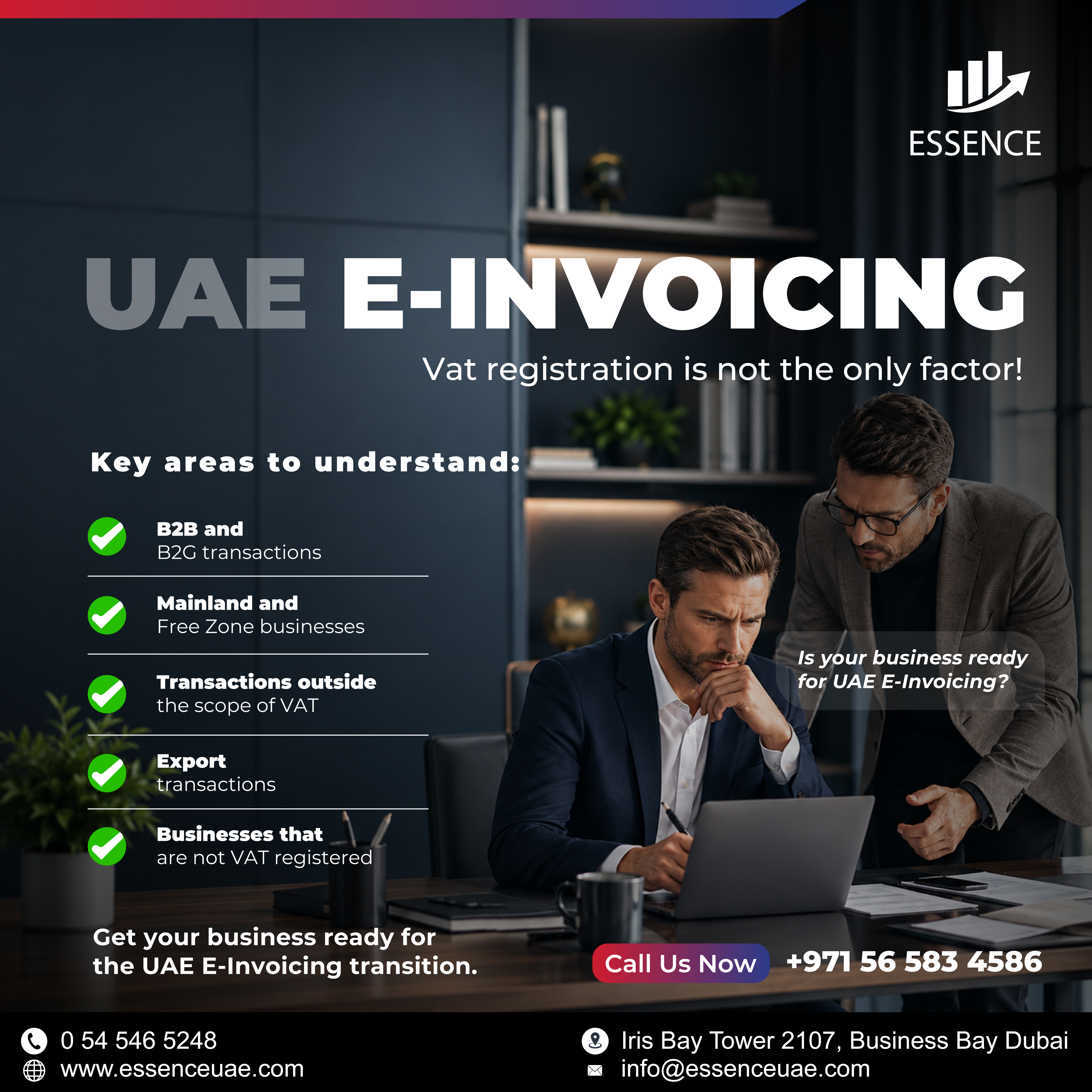
VAT Registration Is Not the Only Factor
Many UAE business owners believe e-invoicing is a problem only for VAT-registered companies. That assumption is one of the most common — and most expensive — misconceptions of the UAE tax landscape.
The UAE Ministry of Finance has made it clear: the scope of the national e-invoicing system is not tied to VAT registration status. Under Ministerial Decision No. 243 of 2025, the mandate applies to all persons conducting business in the UAE in respect of their business transactions, unless specifically excluded.
In plain terms: you can be below the VAT registration threshold, operating in a free zone, or entirely unregistered — and still be legally required to issue structured electronic invoices through an Accredited Service Provider (ASP). If your business invoices other businesses, this guide explains exactly where you stand, what your deadlines are, and how to get ready before penalties start applying.
- The mandate covers B2B and B2G transactions. B2C transactions are excluded for now.
- VAT registration is irrelevant to scope — non-VAT-registered businesses issuing commercial invoices to other businesses are in scope.
- Free zone companies are explicitly included. There is no free zone exemption.
- Both mainland and free zone businesses must appoint an ASP and exchange invoices in structured PINT-AE XML format.
- Failure to implement can trigger penalties of AED 5,000 initially, plus AED 5,000 per month of continued non-compliance (capped at AED 50,000 in 12 months), plus AED 100 per non-transmitted invoice.
Key Areas Every UAE Business Must Understand
1. B2B and B2C Transactions
The initial mandate covers domestic B2B and B2G (business-to-government) transactions. B2C transactions — sales to individuals acting as consumers — are currently excluded until the Ministry of Finance issues a further decision.
The critical nuance: B2B applies regardless of whether your customer is VAT registered, corporate tax registered, or neither. As long as you deal with business customers holding a Tax Identification Number (TIN — the first 10 digits of a TRN), the transaction falls within scope. This is precisely why “B2B” and “not VAT registered” are not contradictory concepts under the UAE framework.
2. Mainland and Free Zone Businesses
Operating in a free zone does not take you out of scope. The MoF guidelines (Version 1.1) explicitly confirm that free zone companies — including DMCC, JAFZA, IFZA, RAKEZ, ADGM, and DIFC entities — are within the mandate. A Qualifying Free Zone Person status under UAE corporate tax is not an exemption from e-invoicing.
Mainland companies face identical obligations. In practice, both mainland and free zone businesses must:
- Appoint a MoF-accredited ASP
- Generate invoices in structured PINT-AE XML format (PDFs and emails do not count as e-invoices)
- Transmit invoices through the Peppol-based network, with tax data reported to the FTA
3. Transactions Outside the Scope of VAT
Some transactions fall outside the scope of UAE VAT entirely — exempt supplies, out-of-scope activities, or transactions by persons below the registration threshold. Under the e-invoicing rules, these transactions can still be in scope, because the e-invoicing mandate attaches to business-to-business activity, not to VAT liability.
A simplified example: a design agency below the VAT threshold invoices a corporate client AED 30,000 per month. No VAT is charged — but the invoice is still a B2B commercial invoice, and once the mandate reaches its wave, it must be issued as a structured e-invoice through an ASP.
Non-VAT registered businesses must transmit e-invoices within 14 days of the transaction date (VAT-registered businesses follow the standard VAT time-of-supply rules).
4. Export Transactions
Transactions with overseas customers are covered under the e-invoicing framework. If your overseas customer already participates in the Peppol network in their home country, their Peppol address can be used. If not, the UAE supplier uses a predefined endpoint and continues sharing a human-readable copy (such as a PDF) with the customer alongside the structured data reported to the FTA.
5. Businesses That Are Not VAT Registered
This is the most overlooked group — and the group the MoF has specifically addressed. The guidelines confirm scope “notwithstanding VAT registration status.”
If you carry on business in the UAE and issue B2B commercial invoices, you are expected to comply with the phase applicable to your revenue level. Non-VAT registered businesses should note: your commercial invoices will not carry a TRN, and that is acceptable — but the e-invoicing process, ASP appointment, XML formatting, and FTA reporting obligations still apply to your in-scope transactions.
UAE E-Invoicing Deadlines: Know Your Wave
Implementation is phased by revenue, per Ministerial Decision No. 244 of 2025 (as amended by Ministerial Decision No. 66 of 2026):
| Business Type / Revenue | ASP Appointment By | Mandatory Go-Live |
|---|---|---|
| Pilot / voluntary (all businesses) | Open from 1 July 2026 | No penalties during pilot |
| Revenue ≥ AED 50 million | 30 October 2026 | 1 January 2027 |
| Revenue < AED 50 million | 31 March 2027 | 1 July 2027 |
| Government entities | 31 March 2027 | 1 October 2027 |
| Intra-group (same UAE VAT Tax Group) | Temporarily excluded | Until 31 December 2028 |
Revenue threshold is measured on gross income in your most recent financial statements.
What Compliance Actually Requires
The UAE has adopted a Peppol-based Continuous Transaction Control and Exchange (CTCE) model — often described as a “5-corner” architecture: supplier, supplier ASP, buyer ASP, buyer, and the FTA as the fifth corner.
In practice, your obligations are:
- Appoint one MoF-accredited ASP through the EmaraTax portal. Direct connection to the FTA is not possible.
- Issue invoices and credit notes as structured XML in the PINT-AE format through your ASP.
- Ensure invoice data is reported to the FTA within the prescribed timelines (14 days for non-VAT registered businesses; VAT time-of-supply rules for VAT-registered).
- Retain invoice and credit note data in line with the Tax Procedures Law (generally five years), retrievable by the FTA on request.
- Maintain your registered data with your ASP — changes must be notified promptly.
Invoices must be generated in both Arabic and English under the FTA requirements, and offshore or cloud storage is permitted provided data remains retrievable by the FTA. Your accounting records must align with the invoice data transmitted through the network.
The Penalties for Getting It Wrong
Penalties under the e-invoicing regime apply automatically and are separate from any corporate tax penalties or VAT penalties your business may face.
| Violation | Penalty |
|---|---|
| Failure to implement e-invoicing / appoint an ASP | AED 5,000 initially + AED 5,000/month (capped AED 50,000 / 12 months) |
| Failure to issue and transmit an e-invoice | AED 100 per invoice (capped AED 5,000/month) |
| Failure to issue and transmit an electronic credit note | AED 100 per credit note (capped AED 5,000/month) |
| Failure to notify ASP of changes to FTA-registered data | AED 250 per day of delay (capped AED 5,000/month) |
The indirect costs can be larger than the fines. A buyer who receives a non-compliant invoice may lose the right to recover input VAT on that supply, and the expense can also fail as a corporate tax deduction. Commercially, government bodies and large enterprise buyers will not accept invoices they cannot process through the network — which can quietly remove a non-compliant supplier from tenders and procurement frameworks.
Is Your Business Ready? A Quick Self-Assessment
Ask your team these six questions:
- Do we issue invoices to other businesses (any size, mainland or free zone)?
- Are we below the VAT threshold — and have we confirmed whether e-invoicing still applies to us? (It likely does.)
- Do we know which wave we fall into based on our latest financial statements?
- Have we selected and appointed an accredited ASP?
- Can our accounting software generate PINT-AE XML and integrate with an ASP, or do we need middleware?
- Have we tested end-to-end issuance, receipt, and FTA reporting — ideally during the penalty-free voluntary phase?
If you answered “no” or “not sure” to any of these, an e-invoicing readiness assessment is the fastest way to close the gaps before your deadline.
Get Your UAE E-Invoicing Readiness Assessment
Not sure if your business is in scope, or which wave you fall under? Essence Accounting & Tax Consultancy provides e-invoicing scope assessments, ASP selection advisory, and integration support for mainland and free zone businesses across Dubai and the UAE.
Frequently Asked Questions: UAE E-Invoicing Requirements
Is e-invoicing mandatory in the UAE if I am not VAT registered?
Yes, most likely. The mandate applies to persons conducting business in the UAE for B2B and B2G transactions regardless of VAT registration status. Under Ministerial Decision No. 243 of 2025, if you issue commercial invoices to business customers, you fall within scope unless a specific exclusion applies. Your invoices will not carry a TRN, but the ASP appointment, XML formatting, and FTA reporting obligations still apply.
Are free zone companies exempt from UAE e-invoicing?
No. The Ministry of Finance guidelines explicitly confirm that free zone businesses — including DMCC, JAFZA, IFZA, RAKEZ, ADGM, and DIFC companies — are within scope. Qualifying Free Zone Person status under corporate tax does not create an exemption from e-invoicing. Free zone companies face the same obligations as mainland companies: appoint an ASP, issue PINT-AE XML invoices, and report to the FTA.
Is a PDF invoice an e-invoice in the UAE?
No. PDFs, scanned invoices, and invoices sent by email do not qualify as e-invoices under the UAE framework. A compliant UAE e-invoice must be structured XML in the PINT-AE format, exchanged through an MoF-accredited ASP connected to the Peppol network, with tax data reported to the FTA. Human-readable formats (PDF or printout) can be shared with the customer as a supplement, but they are not the legal invoice record.
Do B2C businesses need to comply with UAE e-invoicing?
Not currently. B2C transactions — sales to individuals acting as consumers — are excluded until the Ministry of Finance issues a further decision extending the mandate to B2C. However, businesses making both B2B and B2C sales must comply for the B2B portion. If you invoice any corporate or business customers, that portion of your activity is in scope regardless of your B2C volume.
What is the UAE e-invoicing deadline for small businesses under AED 50 million?
Businesses with annual revenue below AED 50 million must appoint a MoF-accredited ASP by 31 March 2027 and implement mandatory e-invoicing from 1 July 2027, per Ministerial Decision No. 244 of 2025. The revenue threshold is measured on gross income in your most recent financial statements. The voluntary pilot phase (open from 1 July 2026) allows smaller businesses to test without penalty exposure before the mandatory date.
Can I test UAE e-invoicing before my mandatory date?
Yes. The pilot and voluntary adoption window opened on 1 July 2026. Any business can appoint an ASP and begin issuing PINT-AE XML invoices voluntarily during this window. Participating early lets you test integration, resolve accounting software compatibility issues, train your team, and identify data gaps — all without exposure to penalties. Early participation is strongly recommended before the AED 5,000+ penalty clock starts on your mandatory go-live date.
