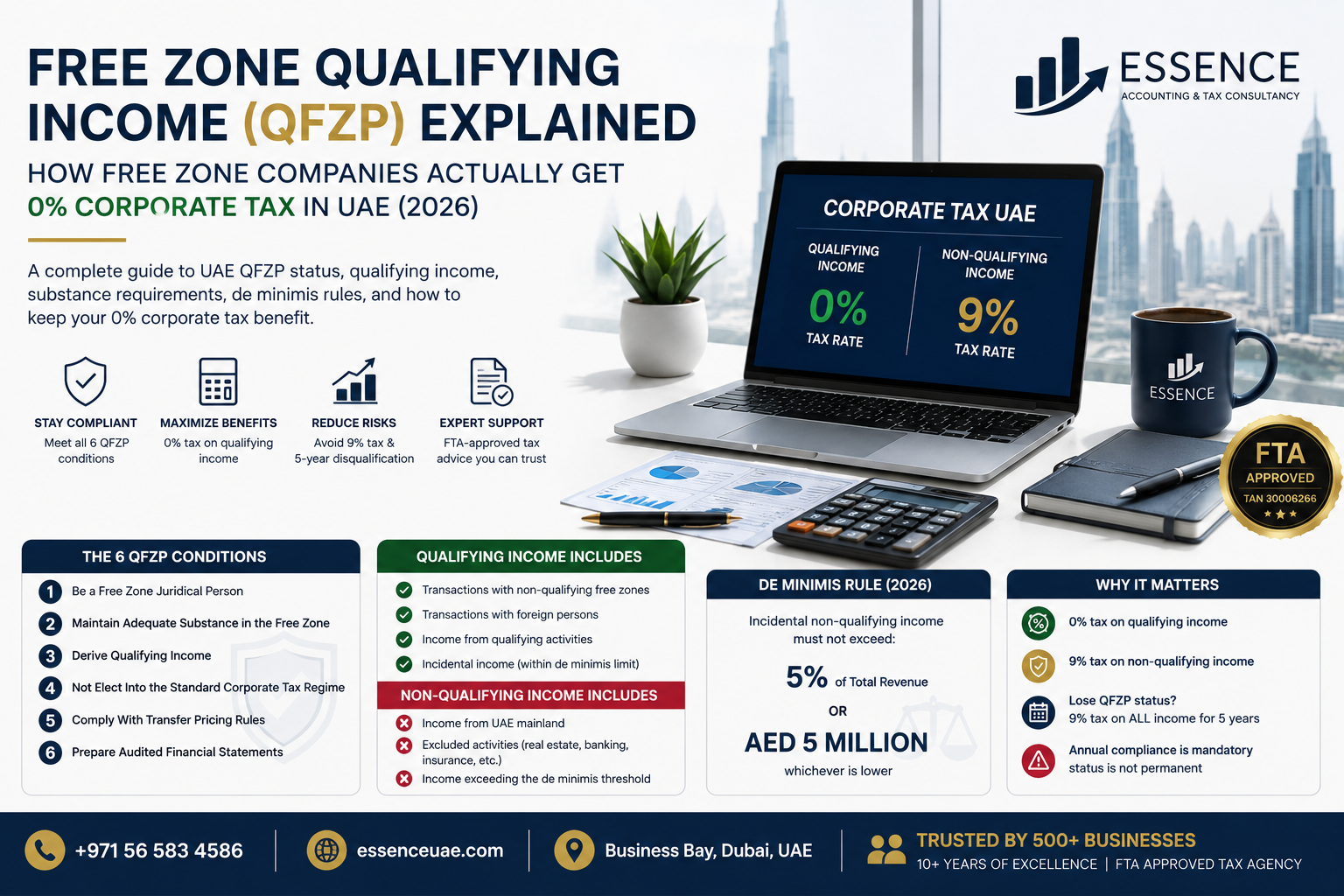
Free Zone Qualifying Income (QFZP) Explained: How Free Zone Companies Actually Get 0% Corporate Tax (2026)
Complete 2026 guide to UAE Qualifying Free Zone Person (QFZP) status. Learn the 6 conditions for 0% corporate tax, qualifying vs non-qualifying income, de minimis rules, and how to avoid the 5-year disqualification trap. FTA-approved advice from Essence UAE.
Introduction
The UAE's free zones
have long been magnets for international investors, offering 100% foreign
ownership, streamlined incorporation, and access to global trade hubs. But with
the introduction of Corporate Tax under Federal Decree-Law No. 47 of 2022, one question
dominates every free zone boardroom in Dubai, Abu Dhabi, and Sharjah: How do we
actually keep our 0% tax rate?
The answer lies in becoming a Qualifying Free Zone Person (QFZP) â a status
that is neither automatic nor guaranteed. It must be earned through strict
compliance with substance requirements, income classification rules, and
ongoing monitoring. Get it right, and your free zone company pays 0% on
qualifying income. Get it wrong, and you face 9% tax on ALL income for five
years.
At Essence Accounting & Tax Consultancy LLC â an FTA-Approved Tax Agency
with TAN 30006266 â we have guided 500+ UAE businesses through the QFZP maze.
This guide breaks down exactly how free zone companies qualify for 0% corporate
tax in 2026, what income counts as qualifying, and the costly traps that strip
companies of their tax benefits overnight.
What Is a Qualifying Free Zone Person (QFZP)?
A Qualifying Free
Zone Person (QFZP) is a Free Zone entity that meets all conditions under
Article 18 of the UAE Corporate Tax Law (Federal Decree-Law No. 47 of 2022), as
clarified by Ministerial Decision No. 229 of 2025 (which replaced the earlier
Ministerial Decision No. 265 of 2023, retroactively applying from the start of
the regime).
Key facts for 2026:
⢠A QFZP pays 0% Corporate Tax on Qualifying Income.
⢠Non-qualifying income is taxed at the standard 9% rate.
⢠QFZP status is assessed for EACH tax period â it is not permanent.
⢠All free zone companies must register for Corporate Tax and file annual
returns, even if 0% tax is due.
⢠QFZPs cannot form or join Corporate Tax Groups.
⢠QFZPs cannot elect for Small Business Relief (SBR).
Important: A free zone license alone does NOT make you a QFZP. The status must
be actively maintained through compliance.
The 6 Conditions Every QFZP Must Meet
To qualify as a
QFZP, a free zone company must satisfy ALL six conditions simultaneously.
Missing even one collapses the status for the entire tax period.
Condition 1: Be a Free Zone Juridical Person
⢠Must be incorporated, established, or registered in a UAE Free Zone.
⢠Branches of foreign companies registered in a free zone are included.
⢠Sole traders, freelancers, natural persons, and unincorporated partnerships
do NOT qualify.
⢠A UAE mainland company with a free zone branch creates a Free Zone Person at
branch level only.
⢠A free zone company operating through a mainland branch creates a Domestic
Permanent Establishment (DPE), taxed at 9%.
Condition 2: Maintain Adequate Substance in the Free Zone
This is the most scrutinized condition. The FTA applies a case-by-case
assessment. Your company must demonstrate:
⢠Core Income-Generating Activities (CIGAs) conducted within the free zone.
⢠Adequate assets proportionate to the business (office, warehouse, equipment).
⢠Adequate number of qualified full-time employees based in the free zone.
⢠Adequate operating expenditure incurred in the free zone.
⢠Physical presence: commercial offices, facilities, or shared/flexible offices
that are reasonable for the business nature.
⢠Decision-making and management conducted from the free zone.
A company with only a registered address, no staff, and no meaningful
operations will FAIL the substance test.
Condition 3: Derive Qualifying Income
Not all income earned in a free zone qualifies for 0%. Only income from
specific activities and transactions counts. (See detailed breakdown below.)
Condition 4: Not Elect Into the Standard Corporate Tax Regime
A free zone company can voluntarily elect to be taxed under the standard 9%
regime. Once made, this election applies for the current tax period AND the
next four tax periods. You cannot reverse it early. After five years, you may
re-apply for QFZP status if all conditions are met.
Condition 5: Comply With Transfer Pricing Rules
⢠All related-party transactions must be at arm's length.
⢠Documentation obligations apply at certain thresholds (Master File, Local
File for larger groups; Country-by-Country reporting for very large MNEs).
⢠A transfer pricing disclosure must be filed with the Corporate Tax Return.
Condition 6: Prepare Audited Financial Statements
⢠QFZPs MUST prepare and maintain audited IFRS financial statements annually.
⢠Unaudited management accounts are insufficient.
⢠Each Free Zone maintains its own Approved Auditors List â your auditor must
be on that list.
⢠Audits support the accuracy of accounting profit, income segregation, and tax
filings.
⢠Financial records must be retained for at least 7 years.
Qualifying Income vs. Non-Qualifying Income: The Complete Breakdown
Qualifying Income
(Taxed at 0%):
Category 1: Income from Transactions with Other Free Zone Persons
⢠Goods or services provided to another Free Zone Person.
⢠The counterparty must be the beneficial recipient â not a conduit, agent,
nominee, or intermediary.
⢠The FTA recommends obtaining a written statement/undertaking from the free
zone counterparty confirming beneficial recipient status.
⢠If the transaction involves an excluded activity, the income is
non-qualifying even with a free zone counterparty.
Category 2: Income from Qualifying Activities (Even with Non-Free Zone Persons)
⢠Manufacturing and processing of goods or materials.
⢠Holding of shares and other securities (subject to specific conditions).
⢠Ship operation and management.
⢠Reinsurance services regulated in the UAE.
⢠Fund management services regulated in the UAE.
⢠Wealth and investment management services regulated in the UAE.
⢠Headquarters and group services to related parties.
⢠Treasury and financing services to related parties.
⢠Financing and leasing of aircraft and components.
⢠Distribution of goods or materials in or from a Designated Zone to non-UAE
customers.
⢠Qualifying intellectual property (IP) income â derived from patents,
software, or similar assets developed by the company with proper R&D
expenditure (nexus approach applies).
Category 3: Qualifying Intellectual Property Income
⢠Only IP developed through qualifying R&D expenditure qualifies.
⢠Trademark royalties and trade name income NEVER qualify as QFZP IP income.
⢠The nexus approach requires linking IP income to qualifying R&D
activities.
Non-Qualifying Income (Taxed at 9%):
⢠Income from transactions with mainland UAE persons that is NOT derived from
Qualifying Activities.
⢠Income from excluded activities (see below).
⢠Income attributable to a Domestic or Foreign Permanent Establishment.
⢠Certain real estate income (ownership, leasing, or exploitation of immovable
property in the UAE, unless it is commercial property in a free zone leased to
another Free Zone Person).
⢠Non-qualifying IP income (trademarks, trade names).
⢠Income from natural persons, except for certain regulated activities (fund
management, wealth management, aircraft leasing, ship operations).
⢠Banking, insurance, and regulated finance and leasing activities (unless
falling within qualifying categories like treasury services to related
parties).
Excluded Activities (Income Always Non-Qualifying):
⢠Transactions with natural persons (with limited exceptions).
⢠Banking, insurance, and regulated finance/leasing activities.
⢠Ownership or operation of UAE real estate (outside specific free zone
commercial property exceptions).
⢠Activities ancillary or supporting any excluded activity.
The De Minimis Rule: The AED 5 Million Cliff
The de minimis rule
is the safety valve that allows QFZPs to earn SOME non-qualifying income
without losing their status entirely. But it is a cliff-edge rule â one dirham
over, and you fall.
The Rule:
Non-qualifying revenue must NOT exceed the LOWER of:
⢠5% of total revenue, OR
⢠AED 5,000,000
Example 1:
A DMCC trading company has total revenue of AED 80 million. 5% of AED 80M = AED
4M. The de minimis cap is AED 4M (lower than AED 5M). If non-qualifying income
exceeds AED 4M, QFZP status is lost for the current year AND the next four
years.
Example 2:
A JAFZA logistics company has total revenue of AED 120 million. 5% of AED 120M
= AED 6M. The de minimis cap is AED 5M (lower than AED 6M). If non-qualifying
income exceeds AED 5M, QFZP status is lost.
Critical Points:
⢠The test applies to the ENTIRE tax period, not quarterly or monthly.
⢠Income from a Domestic/Foreign Permanent Establishment and certain real
estate categories is EXCLUDED from the de minimis calculation â but is still
taxed at 9%.
⢠If the threshold is breached, 9% tax applies to ALL taxable income, not just
the excess non-qualifying portion.
⢠The company is disqualified for FIVE years (current year + next four).
Pro Tip from Essence UAE:
Run the de minimis test QUARTERLY. Do not wait until year-end. If you are
approaching the threshold, restructure transactions, shift revenue timing, or
adjust your business mix before the tax period closes.
The 5-Year Disqualification Trap: What Happens When You Lose QFZP Status
Losing QFZP status
is not a minor setback â it is a five-year financial earthquake.
If a free zone company fails ANY qualifying condition in a tax period:
1. It ceases to be a QFZP from the BEGINNING of that tax period (not from the
date of failure).
2. It remains disqualified for that period AND the next four tax periods.
3. ALL taxable income is subject to 9% during the lockout period (with the
standard AED 375,000 nil-rate band).
4. It cannot access Small Business Relief during disqualification.
5. It may be able to form or join a Corporate Tax Group during
disqualification.
6. After five full tax periods, it may re-test and re-apply for QFZP status if
ALL conditions are met.
Common Triggers for Disqualification:
⢠Breaching the de minimis threshold by even AED 1.
⢠Failing the substance test (no employees, no physical office, no genuine
operations).
⢠Earning income from excluded activities above the threshold.
⢠Voluntarily electing into the standard tax regime.
⢠Failing transfer pricing compliance on related-party transactions.
⢠Not preparing audited financial statements.
⢠Weak income segregation in financial statements â the FTA cannot distinguish
qualifying from non-qualifying streams.
Example:
A DIFC consultancy earns AED 800,000 from UAE mainland clients out of total
revenue of AED 3 million (26.7% non-qualifying, above the 5% threshold). The
company loses QFZP status. For the current year and the next four years, ALL
income is taxed at 9%. At a taxable profit of AED 1.5M per year, the five-year
tax cost is approximately AED 607,500 â versus AED 0 under QFZP status.
How to Register and File as a QFZP â Step-by-Step 2026 Guide
Step 1: Confirm Free
Zone Juridical Person Status
Verify your company is incorporated or registered in a UAE Free Zone and holds
a valid license from the relevant Free Zone authority.
Step 2: Register for Corporate Tax via EmaraTax
⢠All free zone companies MUST register, even if expecting 0% tax.
⢠Apply through the EmaraTax portal (tax.gov.ae).
⢠Obtain your Corporate Tax Registration Number (CT TRN).
⢠Registration deadlines are based on your trade licence issuance month.
Step 3: Map Every Revenue Stream
For each revenue stream, document:
⢠Counterparty type (Free Zone Person / non-Free Zone Person / individual).
⢠Beneficial recipient status (obtain written confirmation for free zone
transactions).
⢠Underlying activity classification (Qualifying / Excluded / Ancillary).
⢠Whether an absolute exclusion applies (DPE, FPE, immovable property,
non-qualifying IP).
Step 4: Maintain Substance Contemporaneously
Keep evidence organized as the year runs:
⢠Lease agreements for free zone premises.
⢠Employment contracts and payroll records for free zone-based staff.
⢠Board meeting minutes and decision records showing free zone management.
⢠Capex and opex documentation reflecting free zone operations.
⢠Operational records linking activities to the free zone.
Step 5: Run the De Minimis Test Quarterly
⢠Calculate non-qualifying revenue vs. total revenue every quarter.
⢠If approaching the threshold, take corrective action before year-end.
⢠Remember: income from DPE/FPE and certain real estate is excluded from de
minimis but still taxed at 9%.
Step 6: Prepare Audited Financial Statements
⢠Engage an auditor from your Free Zone's Approved Auditors List.
⢠Ensure financial statements clearly segregate qualifying and non-qualifying
income.
⢠Apply defensible cost allocation methodology.
⢠Conduct functional analysis for related-party transactions.
Step 7: File Your Corporate Tax Return
⢠Deadline: 9 months from the end of your financial year.
⢠Declare QFZP status in the return.
⢠Tag qualifying vs. non-qualifying income accurately.
⢠Include transfer pricing disclosure where applicable.
⢠Submit audited financial statements as supporting documentation.
Step 8: Conduct Annual QFZP Health Check
⢠Re-test eligibility at the start of each tax period.
⢠Reassess before launching new services or onboarding new customer types.
⢠Review substance evidence annually.
⢠Update beneficial recipient confirmations for free zone counterparties.
10 Hidden Traps That Strip QFZP Status
Trap 1: The
All-or-Nothing Failure
One breached condition triggers 9% on ALL income â not just the non-qualifying
portion.
Trap 2: Crossing De Minimis by AED 1
A breach by a single dirham is still a breach. There is no grace margin.
Trap 3: Mainland Customers for Non-Qualifying Activities
Mainland customers are not the issue â the activity classification is.
Consultancy services to mainland clients are non-qualifying and accumulate
quickly.
Trap 4: Beneficial Recipient Failures
Agent, nominee, and intermediary structures fail the beneficial recipient test.
Always obtain written confirmation.
Trap 5: Substance Erosion Over Time
Relocating staff, shifting decision-making to another country, or reducing
genuine free zone operations can silently erode substance.
Trap 6: Immovable Property Income Traps
Qualifying treatment is narrow. Commercial property in a free zone leased to
another Free Zone Person CAN qualify; other scenarios likely fall outside.
Trap 7: Trademarks and Trade Names Never Qualify as IP Income
Only patents, software, and similar assets developed through qualifying R&D
qualify. Trademark royalties are always non-qualifying.
Trap 8: The 51% Logistics Revenue Test for Commodity Traders
If logistics, warehousing, or inventory management revenue exceeds 51% of total
revenue, commodity trading qualifying status can be lost under Ministerial
Decision No. 229 of 2025.
Trap 9: Opting Out Locks You In
A voluntary election into the standard 9% regime applies for the current period
plus four more. The timing of that decision matters enormously.
Trap 10: Weak Income Segregation in Financial Statements
QFZPs need financial statements that clearly separate qualifying and
non-qualifying streams with defensible cost allocation. The FTA will scrutinize
this during audits.
QFZP vs. Non-QFZP vs. Mainland: Which Structure Is Right for You?
| Feature | QFZP |
Non-QFZP (Free Zone) | Mainland Entity |
|---|---|---|---|
| Corporate Tax Rate on Qualifying Income | 0% | 9% | 0% below AED 375K; 9%
above |
| Corporate Tax Rate on Non-Qualifying Income | 9% | 9% | 0% below AED 375K; 9%
above |
| Adequate Substance Test | Mandatory | Not applicable | Not applicable |
| Audited Financial Statements | Mandatory annually | Depends on structure |
Only if revenue > AED 50M |
| Can Form Tax Groups | No | Yes | Yes |
| Can Elect Small Business Relief | No | Yes (if eligible) | Yes (if eligible)
|
| De Minimis Rule | Yes | No | No |
| 5-Year Disqualification Risk | Yes | No | No |
| 100% Foreign Ownership | Yes | Yes | Yes (since 2021) |
| Best For | B2B free zone trading, manufacturing, holding companies, regulated
services | Free zone companies not meeting QFZP criteria | B2C services,
banking, insurance, real estate, large-scale mainland operations |
Compliance Requirements & FTA Penalties for QFZPs in 2026
Registration:
⢠All free zone companies must register for Corporate Tax via EmaraTax.
⢠Failure to register: AED 10,000 fixed penalty.
Filing:
⢠Corporate Tax Return due within 9 months of financial year-end.
⢠Late filing: AED 1,000â10,000+ depending on delay.
⢠The return must clearly distinguish qualifying vs. non-qualifying income.
Record Keeping:
⢠Maintain financial records and supporting documents for at least 7 years.
⢠Include substance evidence, income source documentation, and transfer pricing
records.
⢠Audited financial statements are mandatory for QFZPs.
Transfer Pricing:
⢠Related-party transactions must be at arm's length.
⢠Transfer pricing disclosure required with the tax return.
⢠Master File and Local File obligations apply at prescribed thresholds.
2026 Penalty Framework:
⢠Late payment: 2% monthly on unpaid tax.
⢠Incorrect return: Up to 300% of tax shortfall in cases of tax evasion.
⢠The UAE has reduced certain penalties under updated frameworks, but QFZP
status loss carries its own massive cost â five years at 9%.
Key Dates & Deadlines for QFZPs in 2026
⢠Corporate Tax
Registration: Based on trade licence issuance month â check EmaraTax for your
specific deadline.
⢠Tax Return Filing: 9 months from the end of your financial year.
â 31 December 2025 year-end â File by
30 September 2026
â 31 March 2026 year-end â File by 31
December 2026
â 30 June 2026 year-end â File by 31
March 2027
⢠QFZP Status Assessment: Conducted for each tax period â there is no permanent
approval.
⢠Audit Appointment: Schedule with an Approved Auditor at least 3 months before
your filing deadline.
⢠Transfer Pricing Documentation: Prepare contemporaneously throughout the
year, not at year-end.
Frequently Asked Questions (FAQs)
Q: Do all free zone
companies automatically get 0% corporate tax?
A: No. Only companies that meet ALL QFZP conditions qualify for 0% on
qualifying income. A free zone license alone is not enough.
Q: Can a free zone company with mainland customers still be a QFZP?
A: Yes, but only if the income from mainland customers is derived from
Qualifying Activities AND non-qualifying income stays within the de minimis
threshold.
Q: What happens if my non-qualifying income is AED 5,000,001?
A: You lose QFZP status for the current year and the next four years. All
income is taxed at 9%.
Q: Can I be a QFZP and also elect for Small Business Relief?
A: No. QFZPs are explicitly excluded from Small Business Relief.
Q: Do I need employees in the free zone to maintain QFZP status?
A: Yes. Adequate substance requires qualified full-time employees based in the
free zone. The exact number depends on your business scale and nature.
Q: Can I outsource my core activities and still be a QFZP?
A: Yes, but only to another Free Zone Person (related or third party), and you
must maintain adequate supervision. For qualifying IP income, outsourcing to
non-related parties outside the UAE is also permitted.
Q: What if my free zone company is still in the preparatory phase with no
revenue?
A: Early-stage businesses in a preparatory phase can retain QFZP status for
that period. Lack of revenue alone does not disqualify you, but you must still
demonstrate substance intent.
Q: Can I switch from QFZP to standard tax and back?
A: You can voluntarily elect into the standard regime, but you are locked in
for five years (current + four subsequent). After five years, you may re-apply
for QFZP status if all conditions are met.
Q: Are audited financial statements mandatory even if I have zero tax due?
A: Yes. Audited IFRS financial statements are a mandatory condition for QFZP
status, regardless of tax liability.
Q: Which free zones are best for QFZP status?
A: DMCC, JAFZA, DIFC, ADGM, RAK Free Zone, IFZA, and JLT are among the most
popular. The best choice depends on your activity type, target market, and
substance requirements.
People Also Search For
1. What is QFZP
status in UAE?
A Qualifying Free Zone Person is a
free zone entity meeting six strict conditions to enjoy 0% corporate tax on
qualifying income under UAE Corporate Tax Law.
2. How do I qualify for 0% corporate tax in UAE free zone?
Meet all six QFZP conditions: free
zone juridical person status, adequate substance, qualifying income, no
standard tax election, transfer pricing compliance, and audited financial
statements.
3. What is the de minimis threshold for QFZP UAE?
Non-qualifying revenue must not exceed
the lower of 5% of total revenue or AED 5 million per tax period.
4. What happens if I lose QFZP status?
You pay 9% corporate tax on ALL income
for the current year and the next four tax periods. You cannot access Small
Business Relief during disqualification.
5. Can free zone companies pay 0% tax in UAE?
Only QFZPs earning qualifying income
can pay 0%. Non-QFZPs and free zone companies breaching conditions pay 9%.
6. What are qualifying activities for QFZP UAE?
Manufacturing, trading, holding
shares, ship management, regulated fund/wealth management, HQ services,
treasury services, aircraft leasing, distribution from Designated Zones, and
qualifying IP income.
7. Do free zone companies need to file corporate tax returns?
Yes. All free zone companies must
register and file annual Corporate Tax returns via EmaraTax, even if 0% tax is
due.
8. What is the penalty for not registering for corporate tax in UAE free zone?
AED 10,000 fixed penalty for failure
to register. Late filing penalties range from AED 1,000 to AED 10,000+.
9. Can I outsource core activities and maintain QFZP status?
Yes, to another Free Zone Person with
adequate supervision. For qualifying IP, outsourcing to non-related parties
outside the UAE is also permitted.
10. Do I need an accountant for QFZP compliance?
While you can self-file, FTA-approved
tax agents like Essence UAE ensure accurate income segregation, substance
documentation, transfer pricing compliance, and audit readiness.
Need QFZP Compliance Support? Contact Essence UAE
Navigating QFZP
status is not a one-time task â it is a year-round discipline. One
misclassified revenue stream, one missing substance document, or one de minimis
miscalculation can cost your free zone company five years of 9% tax on all
income.
At Essence Accounting & Tax Consultancy LLC, we are an FTA-Approved Tax
Agency (TAN 30006266) with a 5.0-star rating and 127+ reviews. We have helped
500+ UAE businesses â including free zone companies in DMCC, JAFZA, DIFC, ADGM,
RAK, and IFZA â structure their revenue correctly, maintain QFZP-ready
reporting, and run ongoing checks across qualifying income, de minimis
exposure, and substance evidence.
â
Free initial consultation
â
FTA-approved tax agents
â
QFZP eligibility assessment and health checks
â
Income segregation and cost allocation strategy
â
Transfer pricing documentation (Master File / Local File)
â
EmaraTax filing and audit coordination
â
Zero penalties for our clients
â
Serving DMCC, JAFZA, DIFC, ADGM, RAK, IFZA, JLT & all Emirates
ð Call/WhatsApp: +971 56 583 4586
ð§ Email: info@essenceuae.com
ð Website: https://essenceuae.com
ð Office: Business Bay, Dubai, United Arab Emirates
Your free zone 0% tax position is only as strong as your compliance. Let
Essence UAE build a QFZP framework that holds up under FTA scrutiny â today and
every tax period.
â
© 2026 Essence Accounting & Tax Consultancy LLC. All Rights Reserved. | FTA-Approved Tax Agency | TAN 30006266
This article is for informational purposes only and does not constitute legal or tax advice. Consult a qualified FTA-approved tax agent for your specific situation.