Introduction
Quarterly VAT filing is often treated as a routine compliance task, but for UAE businesses it is much more than that. The Federal Tax Authority (FTA) uses VAT returns to verify business activity, monitor tax collections, identify inconsistencies, and assess compliance risk. A disciplined quarterly filing process helps businesses avoid penalties, protect cash flow, and stay prepared for audits.
For most VAT-registered SMEs and mid-sized companies, the VAT 201 return is filed every three months through EmaraTax, generally within 28 days after the end of the tax period. Larger businesses may be assigned monthly filing periods, but the principles of accurate record-keeping and timely reporting remain the same.
Key facts at a glance
How quarterly VAT filing works
A VAT return calculates the difference between Output VAT (VAT charged on sales) and recoverable Input VAT (VAT paid on eligible business purchases and expenses).
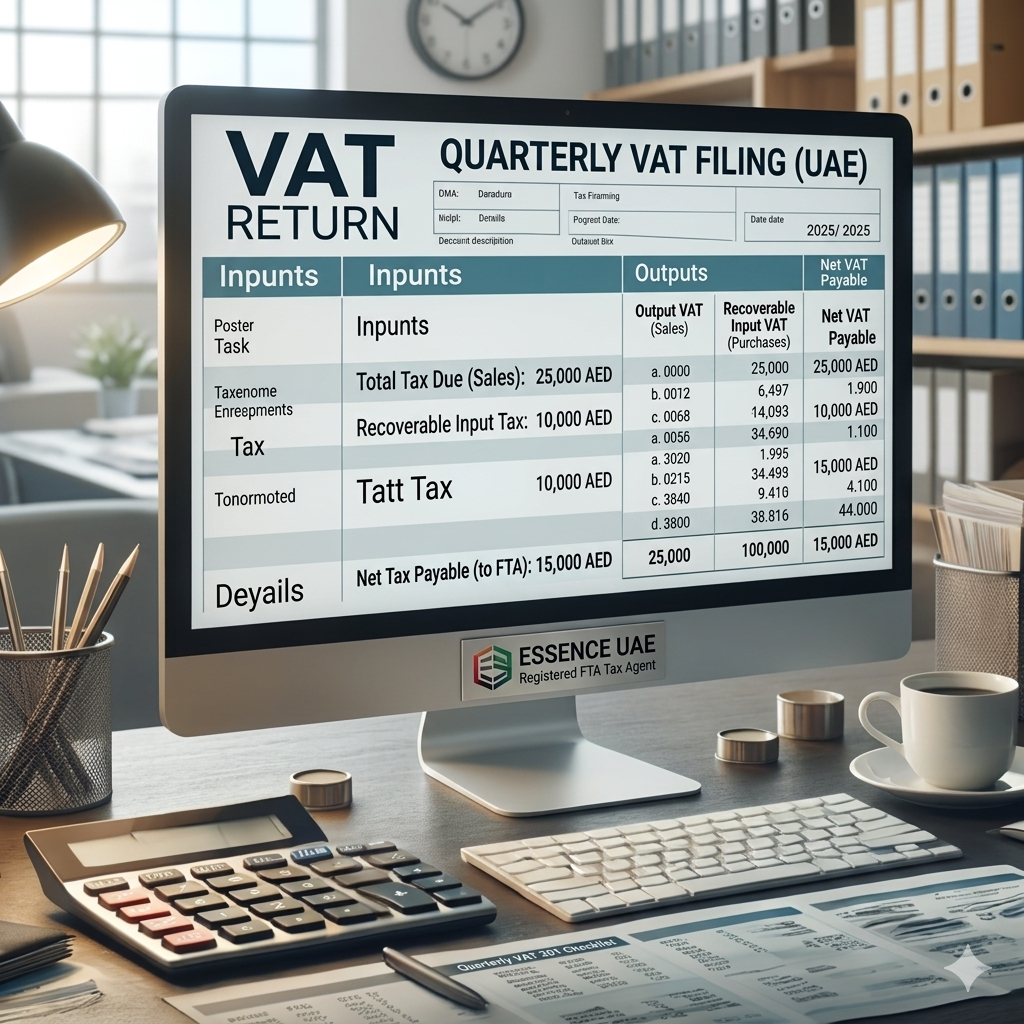
For example, if a business charges AED 25,000 of Output VAT and has AED 10,000 of recoverable Input VAT, the net VAT payable is AED 15,000, subject to the applicable filing and payment deadline.
Why quarterly VAT filing matters
1. It is a legal compliance obligation
Every VAT-registered business must file the return for its assigned tax period, even if the net VAT payable is zero. The FTAâs systems track filing obligations electronically, and non-filing or late filing can trigger administrative penalties.
2. It helps avoid penalties
Common VAT penalties arise from late filing, late payment, incorrect returns, inadequate record-keeping, or non-compliant tax invoices. A consistent quarterly filing process is the simplest way to reduce these risks.
3. It improves cash-flow management
VAT collected from customers is not business revenue. Businesses that fail to segregate VAT funds often face cash shortages when the payment deadline arrives. Quarterly filing creates a structured payment cycle and encourages proper VAT liability tracking.
4. It enables Input VAT recovery
Timely and accurate filing allows businesses to recover eligible VAT on expenses such as office rent, utilities, professional fees, marketing costs, and equipment purchases. Missing or invalid invoices can jeopardize recovery claims.
5. It improves financial reporting
Preparing a VAT return forces businesses to reconcile sales, purchases, bank transactions, and expense documentation every quarter. This discipline usually results in more reliable financial statements and management reports.
6. It reduces audit risk
The FTA conducts compliance reviews and targeted audits. Consistent, well-supported VAT filings with a clear audit trail are less likely to attract adverse scrutiny than irregular, late, or poorly documented submissions.
7. It supports Corporate Tax compliance
Since the introduction of UAE Corporate Tax, VAT records have become an important cross-reference for revenue, expense, and taxable income calculations. Strong VAT processes make Corporate Tax preparation significantly easier.
Common VAT filing mistakes to avoid
Best practices for UAE businesses
Maintain bookkeeping monthly, not just at quarter-end.
Reconcile VAT balances every month to identify issues early.
Use accounting software that supports UAE VAT reporting and EmaraTax workflows.
Verify that supplier invoices meet FTA tax invoice requirements before claiming Input VAT.
Retain invoices, contracts, bank statements, import documents, credit notes, and supporting schedules in an organized archive.
Perform an internal review of the VAT 201 before submission.
Monitor filing and payment deadlines separatelyâfiling the return does not remove the obligation to pay the VAT due on time.
Quarterly VAT compliance checklist
Frequently Asked Questions (FAQ)
1. What is the deadline for a quarterly VAT return in the UAE?
The VAT 201 return is generally due 28 days after the end of the tax period. The VAT payment due follows the same deadline unless the FTA specifies otherwise.
2. Do I still need to file if I had no sales during the quarter?
Yes. A VAT-registered business must file the return for its assigned period even if the net VAT payable is zero.
3. Can I recover Input VAT without a proper tax invoice?
Generally, no. A valid tax invoice and supporting documentation are normally required to support an Input VAT recovery claim.
4. What happens if I file late?
Late filing can trigger administrative penalties and may increase compliance scrutiny from the FTA.
5. Why are VAT records important for Corporate Tax?
VAT returns and reconciliations provide a documented trail of revenue and expenses that can be used as a cross-reference when preparing Corporate Tax computations and returns.
Conclusion
Quarterly VAT filing is not merely a formalityâit is a cornerstone of financial discipline, cash-flow management, and audit readiness for UAE businesses. Companies that reconcile monthly, maintain valid tax invoices, and file accurate VAT 201 returns on time are generally better positioned to avoid penalties, recover eligible Input VAT, and meet both VAT and Corporate Tax obligations with confidence.
As the UAE continues moving toward a more digital tax environment with greater automation and e-invoicing initiatives, businesses that invest in accurate bookkeeping and timely VAT compliance will be better prepared for future regulatory changes and long-term growth.
Need help with VAT 201 filing, reconciliation, or EmaraTax submissions?
Essence UAE assists businesses with bookkeeping reviews, VAT reconciliations, VAT return preparation, and FTA correspondence to help reduce compliance risk and improve reporting accuracy.